
The Roth Transformation
Before You Convert Another Dollar… Read This
Most Roth conversions are done in the least efficient way possible—triggering unnecessary taxes and limiting long-term growth. Here’s a more advanced approach.
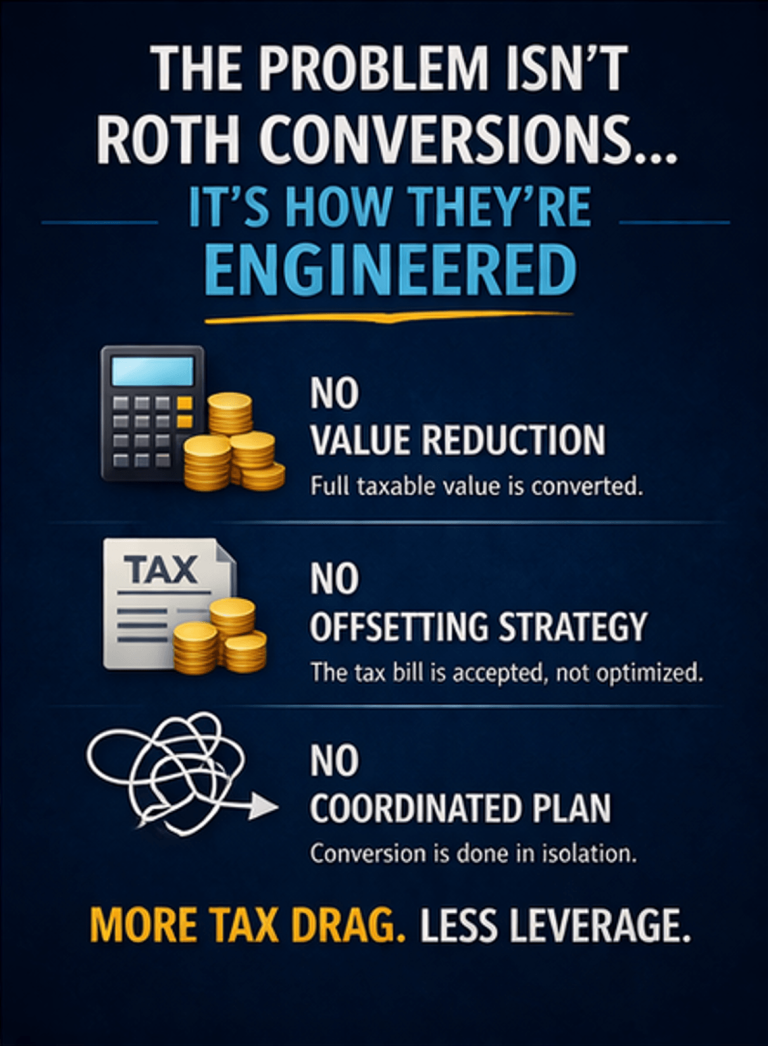
The Problem Isn’t Roth Conversions… It’s How They’re Engineered
For years, investors have been told:
- “Convert to a Roth—it’s tax-free later.”
- “Just spread it out over time.”
- “Stay within your tax bracket.”
That’s the conventional playbook.
And it’s incomplete.
Because what actually determines your outcome isn’t just when you convert…
It’s how intelligently the conversion is engineered from a tax and structural standpoint.
Most conversions are done:
- Without reducing the taxable value being converted
- Without offsetting the tax impact
- Without coordinating with a broader strategy
And the result?
A strategy that should create leverage… ends up creating unnecessary tax drag.
The $300,000 Mistake Most Retirees Don’t See Coming
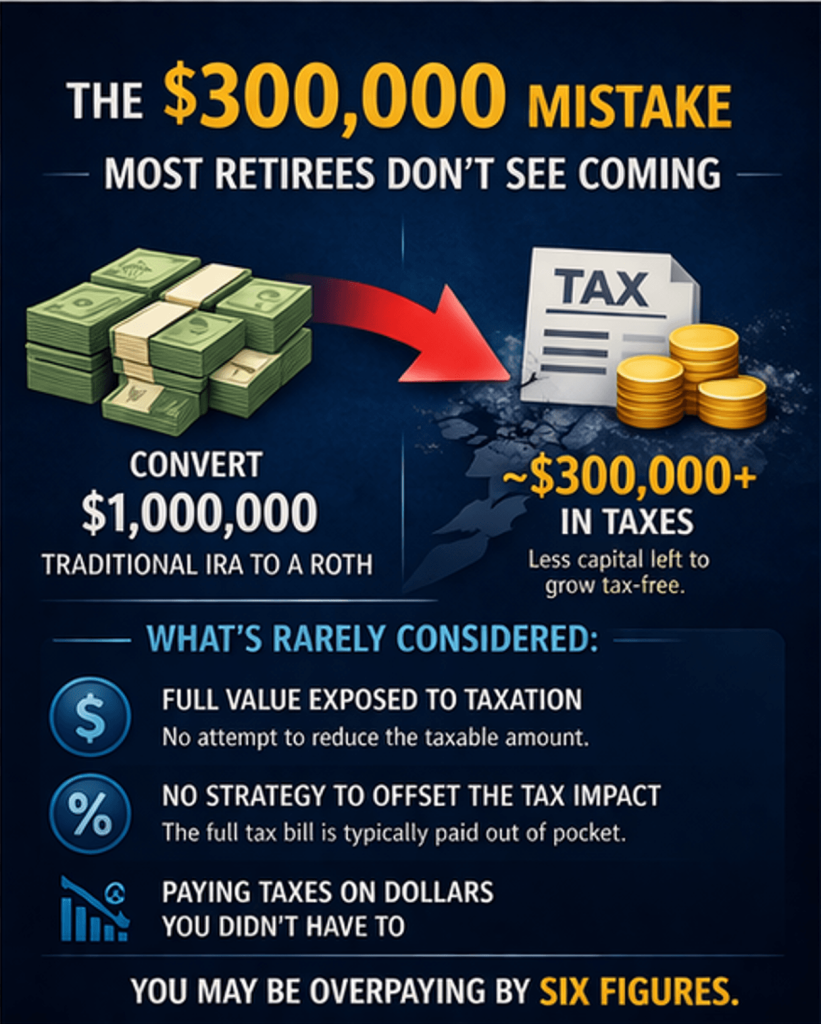
Let’s say you convert $1,000,000 from a traditional IRA to a Roth.
The “normal” approach:
- Taxed at ~30%
- ~$300,000+ paid in taxes
- Less capital left to grow tax-free
But what’s rarely considered:
- The full value is exposed to taxation
- No effort is made to improve tax efficiency
- No strategy is used to offset the tax impact
Which means you may be paying significantly more in taxes than necessary.
What Happens When You Engineer the Outcome
A properly engineered Roth strategy can:
- Reduce the effective tax rate on conversion
- Preserve more capital inside the Roth
- Improve long-term tax-free growth
- Create more efficient retirement income
Not by avoiding taxes—but by structuring the process more intelligently.
.
The Roth Transformation Framework™
A coordinated system designed to convert and optimize retirement accounts using advanced tax-aware structuring and investment strategies.
At the core of this system is:
⚙️ The Tax Alpha Engine™
What Is the Tax Alpha Engine™?
A proprietary approach designed to reduce tax drag and improve the efficiency of Roth conversions through strategic valuation positioning and tax impact offsets.
Most strategies treat taxes as a fixed cost.
The Tax Alpha Engine™ is designed to reshape that cost.
🔹 STEP-BY-STEP PROCESS
🔹 Step 1: Tax Mapping & Income Engineering
We begin by analyzing:
- Your current and projected tax exposure
- Income sources and timing
- Where inefficiencies currently exist
Then we structure your plan to:
- Control how income is recognized
- Identify optimization opportunities
- Build a forward-looking strategy
🔹 Step 2: The Tax Alpha Engine™
This is where the strategy fundamentally differs from the conventional approach.
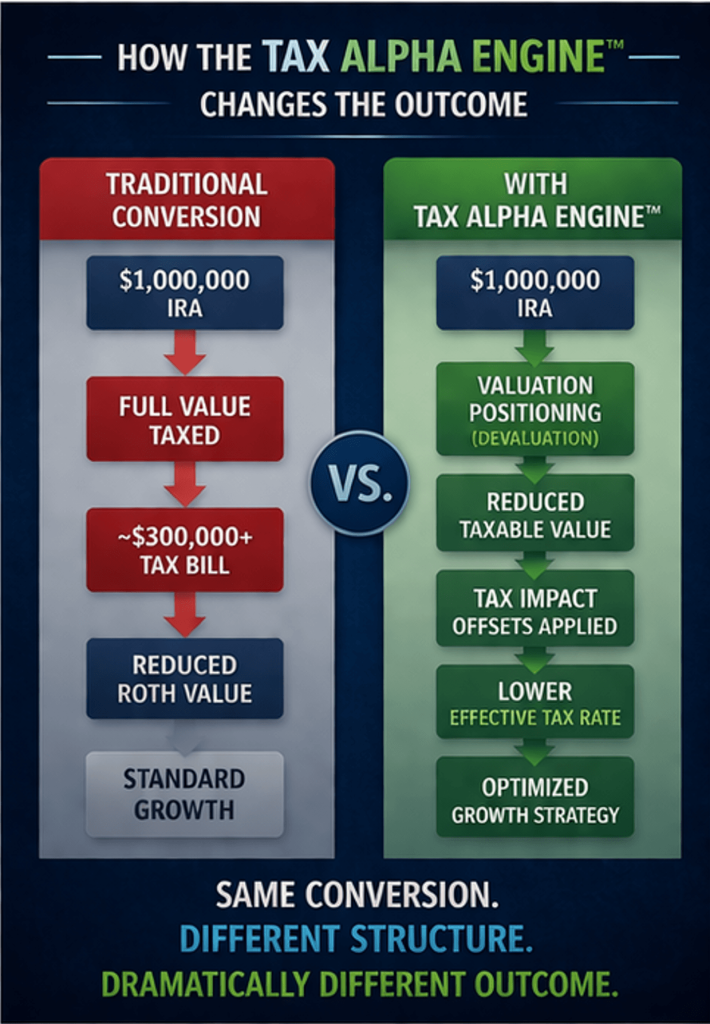
Instead of simply converting the full value and accepting the tax bill…
We activate the core components of the Tax Alpha Engine™:
Our advanced strategy to reduce the taxes associated with Roth conversions
1. Valuation Positioning (Devaluation)
We look for opportunities to:
- Convert assets when their taxable value is temporarily reduced
- Utilize advanced devaluation strategies to intentionally manage the taxable value prior to conversion
- Improve how much value is transferred into the Roth relative to the taxes paid
In simple terms:
The lower the taxable value at conversion… the more efficient the outcome.
2. Tax Impact Offsetting
At the same time, we coordinate strategies designed to:
- Offset a portion of the taxable income created by the conversion
- Reduce the effective tax rate—not just the nominal bracket
- Improve overall after-tax results
🔻 RESULT OF THE ENGINE
Instead of accepting the tax bill…
You actively reshape it.
🔹 Step 3: Retirement Account Optimization
You don’t have to move your investments to work with us.
If your primary goal is to improve how your Roth conversions are structured, we can focus on implementing the Tax Alpha Engine™—while you continue managing your investments the way you do today.
That said…
For those who want to take things further, Step 3 is where full optimization begins.
We focus on:
- How assets are positioned inside the Roth
- Strategies designed specifically for tax-advantaged accounts
- Improving growth on a risk-adjusted basis
Because a Roth account is only as powerful as what happens inside it.
🔹Step 4: Strategic Withdrawal Planning
Finally, we design:
- Tax-efficient withdrawal strategies
- Coordinated income streams across accounts
- A plan to minimize lifetime tax exposure
🔹 Important Distinction
You can benefit from:
- Step 1: Tax Mapping & Income Engineering
- Step 2: The Tax Alpha Engine™
…without changing your current investment management.
But when Steps 3 and 4 are layered in:
That’s when the strategy becomes fully optimized.
Find Out If Your Roth Strategy Is Leaving Money on the Table
We’ll walk through:
- Your current retirement accounts
- Your projected tax exposure
- How the Tax Alpha Engine™ could apply to your situation
What Most Advisors Miss
Most advisors:
- Focus on timing—but not structure
- Treat tax costs as fixed
- Don’t attempt to improve conversion efficiency
- Treat Roth conversions as a transaction—not a system
Which leads to:
- Overpaying taxes
- Missed opportunities
- Less efficient long-term outcomes
Who is this for?The difference isn’t whether you convert.
It’s how intelligently the conversion is engineered.- Individuals with $500,000+ in retirement accounts (ideally $1M+)
- Pre-retirees or retirees concerned about rising taxes
- Investors who want more control over outcomes
- Those who know there’s a more advanced way than standard advice
Find Out If Your Roth Strategy Is Leaving Money on the Table
We’ll walk through:
- Your current retirement accounts
- Your projected tax exposure
- How the Tax Alpha Engine™ could apply to your situation